
When we get enquiries from international architecture students and graduates who want to study, work, or build their careers in the UK, one of the first questions that comes up is whether their existing architecture qualification will help them enter the UK job market.
Some ask whether their qualification is recognised in the UK and whether they need to follow the ARB registration route. Others are more concerned about getting their first UK architecture job, understanding Revit, learning BIM workflows, or knowing what UK firms expect from their portfolio.
These questions are important because having an architecture degree is only one part of preparing for a career in the UK. Graduates also need to understand the professional requirements, work visa options, technical skills, project workflows, and expectations of UK practices.
This guide looks at what international architecture graduates need to know before pursuing work in the UK, from qualifications and ARB requirements to visas, portfolios, Revit, and BIM.
Can International Architecture Graduates Work in the UK?
Yes, international architecture graduates can work in the UK. The route will depend on their qualification, the type of role they are applying for, their experience, and their right to work in the UK.
One important point is that working in an architecture practice is different from working as a registered architect. An international graduate may be able to take on an architecture, design, technical, Revit, or BIM-related role without being registered with the Architects Registration Board (ARB). However, they cannot use the protected title “architect” unless they are registered with ARB.
For graduates who want to eventually qualify as architects in the UK, the next step is to understand how their existing qualification fits into the UK’s professional registration system. This is where ARB requirements become important.
Do You Need ARB Registration to Work in a UK Architecture Practice?
An overseas architecture degree does not automatically become equivalent to a UK ARB-prescribed qualification. But, that does not mean every international graduate has to start their architectural education again in the UK. ARB provides different routes depending on the qualification and the recognition arrangements that apply to it.
What happens with an overseas architecture degree?
Some international qualifications are covered by Mutual Recognition Agreements (MRAs) or other international recognition arrangements. Graduates whose qualifications fall under these routes may be able to use the relevant recognition process when applying for UK registration.
For qualifications that are not recognised through these arrangements, the Prescribed Examination has traditionally provided a route to demonstrate equivalence to the UK Part 1 and Part 2 qualification levels. Depending on their existing qualifications, applicants may need to demonstrate equivalence at one or both levels. They would then normally need to complete a UK Part 3 qualification before applying for registration.
The important point is that a degree with a similar name or level to a UK architecture qualification is not automatically treated as equivalent. The applicable route depends on the applicant’s specific qualification and circumstances, so international graduates should check their position with ARB before deciding whether further UK study is necessary.
ARB Registration Changes in 2027
ARB is introducing a new Registration Assurance Process from spring 2027, changing how applicants demonstrate that they meet the competence requirements for registration. The current Prescribed Examination arrangements are also being replaced as part of these reforms.
For international graduates, this makes it even more important to check the current ARB route for your specific qualification rather than assuming you need to repeat your entire architectural education in the UK.
What Architecture Jobs Can International Graduates Apply For in the UK?
While the exact requirements vary between practices, international graduates can apply for a range of roles across architectural design, technical delivery and digital project work. The right opportunity is not always listed under the title “Architect”.
Common roles include:
- Architectural Assistant: Supporting design development, drawings, presentations and day-to-day project work.
- Architectural Designer: Developing design proposals, drawings, models and visual material across project stages.
- Architectural Technician: Producing technical drawings, construction information and detailed project documentation.
- Revit Technician: Creating and developing architectural models, drawings, sheets and project documentation in Revit.
- BIM Technician: Supporting model development, information production and coordination within BIM workflows.
- BIM Coordinator: Managing model coordination and information exchange between project teams and disciplines.
This wider range of roles is particularly relevant for international graduates because a strong architecture background can be combined with technical or digital skills to enter the UK market through different career paths.
So, what do UK architecture practices actually look for when they assess an international graduate?
What Do UK Architecture Firms Look for in International Graduates?
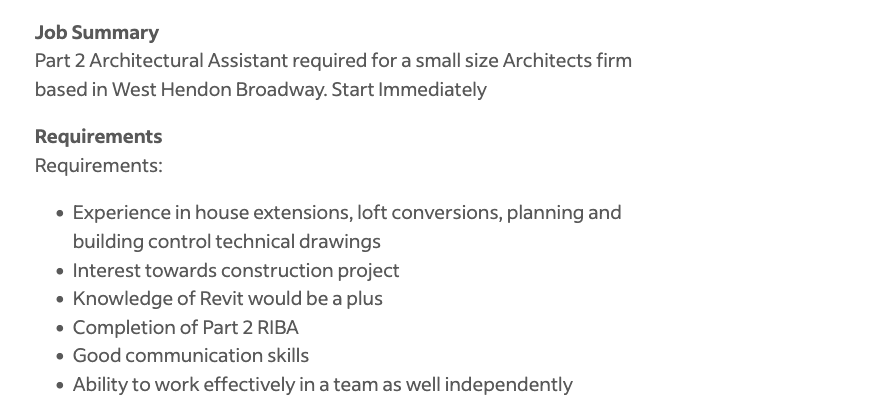
UK architecture practices often work to specific technical standards, regulations and project processes. When reviewing an international graduate, firms therefore look for more than a good design portfolio. Recent UK job descriptions repeatedly ask for technical drawing ability, knowledge of UK regulations and construction, Revit, communication, coordination and the ability to work within a project team.
1. Technical drawings
Employers want to see that you can turn a design into information that can actually be used to develop and build a project.
For an architectural assistant or junior technical role, this can include:
- Producing accurate plans, sections and elevations
- Developing construction details rather than only presentation drawings
- Preparing drawing packages for planning and Building Regulations submissions
- Understanding line weights, annotations, dimensions, levels and drawing references
- Producing coordinated drawings in Revit or AutoCAD
- Updating drawings when consultants or senior architects issue mark-ups
- Maintaining drawing revisions and organised project information
For example, recent UK roles specifically ask candidates to produce technical drawings, schedules, construction documentation and detailed drawing packages using Revit and AutoCAD.
2. UK construction knowledge
A graduate coming from another country may be familiar with different construction systems, materials and detailing methods. UK practices need people who can understand how their drawings relate to construction in the local context.
This means having some practical understanding of:
- Typical UK wall, floor and roof build-ups
- Insulation and cavity construction
- Foundations and structural interfaces
- Windows, doors and junction details
- Materials and their construction requirements
- Existing building surveys and refurbishment
- How architectural information is coordinated with structural and MEP information
- How design information develops from planning into technical design and construction
This is not just theoretical knowledge. UK employers regularly ask for experience with construction detailing, technical standards and the delivery of construction information.
3. Building Regulations awareness
UK projects are designed within a specific regulatory framework, and employers increasingly look for graduates who have at least a working awareness of Building Regulations and the Approved Documents.
At entry level, this does not mean being responsible for compliance yourself. It means understanding how requirements such as fire safety, means of escape, accessibility, ventilation, thermal performance and energy efficiency affect architectural design and documentation.
It is also useful to understand the difference between planning information and Building Regulations information. A graduate who knows that a project does not simply move from “design” straight to “construction” is already closer to how a UK practice operates.
4. Portfolio
Your portfolio is often where an employer first sees whether your skills match the role. For international graduates, it should do more than demonstrate that you can produce attractive architectural visuals.
Show how a project developed from an initial idea into a resolved proposal. Include plans, sections, technical drawings, details, Revit documentation and design iterations where relevant. If you worked on a project as part of a team, clearly explain what you were responsible for.
A portfolio that contains only renders can make it difficult for an employer to understand whether you can contribute to the technical and production side of a project. Showing the process and the decisions behind the final design gives a much clearer picture of your ability.
5. Design development
Firms are not only interested in whether you can produce an attractive concept. They want to see how an idea develops as the project becomes more detailed.
That can mean showing how you:
- Respond to a brief
- Develop layouts and massing
- Test different design options
- Respond to planning constraints
- Resolve circulation and spatial requirements
- Incorporate technical constraints
- Develop a concept into a workable proposal
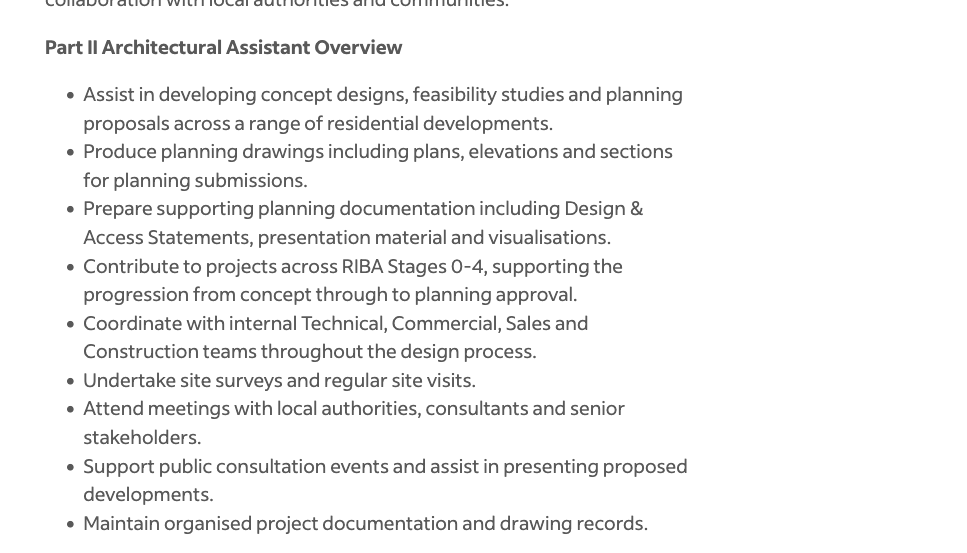
Current Part 2 roles, for example, ask candidates to support projects from concept and feasibility through planning and later stages, rather than working only on initial design ideas.
Is Revit Important for Getting an Architecture Job in the UK?
Yes. Based on the UK architecture job descriptions we reviewed, along with the requirements we regularly see from architecture students and graduates, Revit is one of the most useful technical skills to have when applying for architecture roles in the UK. Employers are not simply looking for candidates who can open Revit and create a basic model. They want people who can use it as part of an actual project workflow.
This includes developing architectural models, producing plans, sections and elevations, setting up sheets, working with families and views, and creating organised project documentation. For technical and BIM-focused roles, employers may also expect an understanding of model coordination and project information management.
The key difference is between knowing Revit and being able to contribute to a live project using Revit. A graduate who can take a design from a developed model through to coordinated drawings and documentation can be much more useful to a practice from the start.
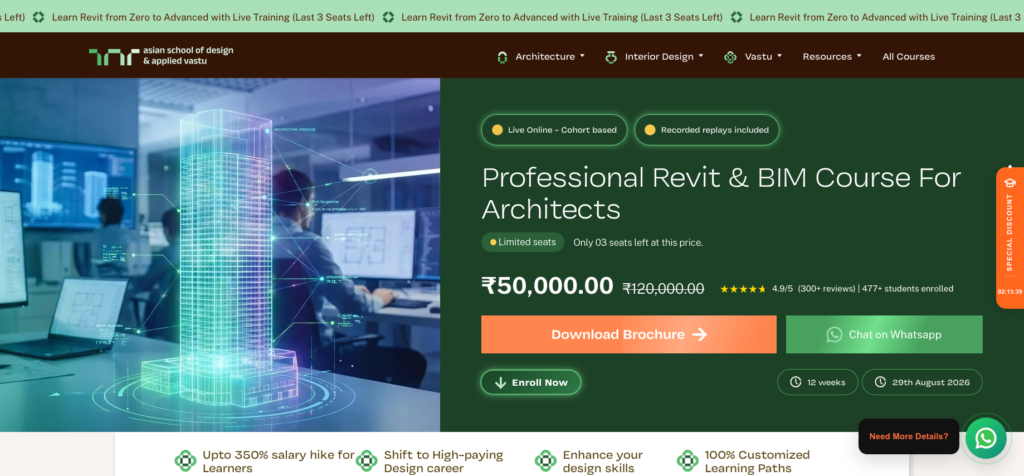
This is why we offer our complete Revit & BIM Certification Course, designed around the skills architecture students and graduates need for professional practice. The 12-week programme includes live sessions, practical project work and UK-focused workflows, helping learners develop Revit and BIM skills that reflect how the software is used in architecture practices.
The focus is not just on individual Revit tools, but on learning how to model, document, coordinate and deliver architectural information as part of a real project workflow.
What BIM Skills Should International Architecture Graduates Learn?
For international graduates, BIM skills can help bridge the gap between architectural education and how multidisciplinary projects are delivered in UK practices.
Key BIM skills include:
- BIM project setup and standards
- ISO 19650 principles
- Common Data Environment (CDE)
- BIM Execution Plans (BEP)
- Information requirements
- Model coordination
- Architectural model development
- Multidisciplinary coordination
- Information exchange and deliverables
- Model checking and quality control
- Naming and revision conventions
- Revit worksharing and collaboration
- Linked and federated models
- Clash detection and coordination
- COBie and structured project information
- BIM documentation and information management
Building a Career in UK Architecture Starts Before Your First Job Application
So, you can work in the UK as an international architecture graduate, but the path will depend on the role you want to pursue, your qualification and your right to work. If your long-term goal is to become a registered architect, you will also need to follow the relevant ARB route, which has its own requirements and process. We will cover the UK architectural registration process in more detail in another guide.
For getting your first role, however, your practical skills matter just as much. Strong Revit, BIM, technical drawing and project workflow skills can help you show employers that you are ready to contribute to a UK practice.
At ASDAV, we help architecture students and graduates build these practical skills through our Revit and BIM courses and masterclasses, with a focus on professional workflows and UK practice. Explore our online architecture courses or connect with our team to find the right programme for your career goals, and start preparing before you send out your first application.

Jasmine Ahluwalia is a Licensed Architect, Interior designer, Global Vastu consultant and the founder of ASDAV.
She is a graduate of Scuola Master F.lli Pesenti, Politecnico di Milano, and brings strong global exposure through academic learning and professional design projects. Her background combines architecture, interior design, and applied design education.
Before founding ASDAV, Jasmine worked as an assistant professor at Amity School of Architecture and Planning, Amity University Noida. Her research covers sustainable architecture, urban heat island reduction, and circular economy practices in construction. Her work has been published in Scopus indexed and peer reviewed journals as well. She also has strong international on-site experience from countries like Canada, Mauritius, UK, and many more.
Through ASDAV, she has trained more than 500 students across 25 cities. The ASDAV platform has 12+ instructors from IIT, SPA, CEPT and NID, and has delivered over 200 live learning sessions. Her mission is to bridge the gap between design education and real industry expectations, to deliver real growth for her students.
She designs spaces for a living, but her favourite project is designing careers.