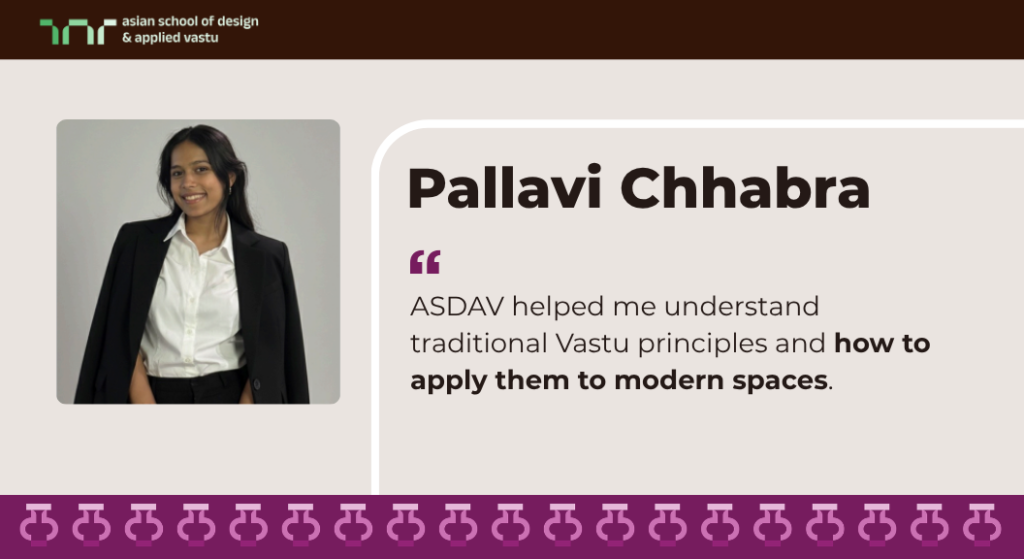
For Pallavi Chhabra, learning Vastu was closely connected to the work she already does as an interior designer. She joined ASDAV’s 6-week Vastu Training Programme to understand traditional Vastu principles and learn how they can be used when planning modern spaces.
The course helped her explore areas such as directions, energy zones, space planning, and residential space analysis. More importantly, she learned how to move from understanding Vastu concepts to using them in actual spaces.
Student Details
- Name: Pallavi Chhabra
- Profession: Interior Designer
- Location: Nagpur
- Course: 6-Week ASDAV Vastu Training Programme
- Area of application: Modern interior and space design
- Key learning from applied Vastu course: Directions, energy zones, space planning, and Vastu analysis of residential spaces
Why did I decide to learn Vastu?
As an interior designer, I wanted to understand how Vastu could fit into the way modern spaces are planned and designed.
During the course, I learned traditional principles of Vastu Shastra and, at the same time, explored how these principles can be applied to contemporary spaces. Understanding directions, energy zones, space planning, and residential space analysis gave me a broader way to look at interiors.
What did I learn during the training?
The course gave me a better understanding of the relationship between Vastu principles and space planning.
I learned about directions and energy zones and how to analyse residential spaces from a Vastu perspective. This helped me look at a space beyond its visual design and consider how traditional Vastu principles can be included in the planning process.
How was the guidance from the mentors?
The mentors and trainers were supportive throughout the course. They explained the concepts clearly and did not keep the learning limited to theory.
Their guidance helped me understand how traditional Vastu ideas could be adapted for modern spaces. This made the subject easier to relate to my own field of interior design.
Did the practical work help?
Yes, the practical assignments were an important part of my learning.
Instead of only studying Vastu concepts, I got the opportunity to use them while analysing spaces. This helped me understand how to approach a space and apply Vastu principles in practice.
For me, this was especially useful because it showed me how the concepts can work outside a classroom setting.
What did I like about ASDAV’s teaching style?
I found the teaching style interactive, practical, and easy to follow.
The mentor used practical examples to explain traditional Vastu concepts and encouraged us to apply what we learned to real spaces. This made the sessions more engaging and helped me understand the subject in a more useful way.
How has Vastu added to my interior design skills?
The course has given me another perspective that I can bring into modern interior and space design.
I can now look at residential spaces with a better understanding of Vastu principles while also considering modern space planning. For me, this makes Vastu a useful addition to my existing design knowledge rather than something separate from it.
How would I describe my overall experience?
My experience at ASDAV was insightful and enriching.
I liked that the course brought together traditional Vastu knowledge and its use in modern spaces. The practical assignments gave me an opportunity to apply what I learned, while the mentor guidance made the concepts easier to understand and use.
Would I recommend ASDAV’s Vastu course?
Yes, I would definitely recommend it to anyone who wants to understand Vastu in a practical way.
What I found valuable was the balance between traditional knowledge and modern application. The supportive mentors and practical learning also made it easier to connect the subject with real spaces and everyday design work.