The UAE, especially Dubai and Abu Dhabi, has become an attractive destination for aspiring interior designers. Over the last few years, opportunities have grown across residential interiors, luxury villas, hotels, restaurants, retail spaces, offices, and commercial projects. The UAE’s strong real estate, hospitality, and construction sectors continue to create demand for designers with the right skills and practical experience.
What makes this career path interesting is that you do not necessarily need a traditional interior design degree to start building your career. With the right training, software skills, technical knowledge, and a strong portfolio, you can prepare for entry-level opportunities and grow through practical experience.
If you are a student, considering a career change, or planning to work in the UAE, this guide will help you understand what employers look for, which skills and software to learn, how to build a UAE-ready portfolio, and what regulations you should know. The guidance is informed by the experience of interior designers who have worked across the UAE and other parts of the world.
What Does An Interior Designer Do In The UAE?
Just like interior designers anywhere else, interior designers in the UAE work on creating spaces that are functional, practical, and visually appealing. However, the scope of work can vary depending on the type of project, client requirements, and the designer’s role within a company or studio.
Typical responsibilities include:
- Understanding client requirements and project briefs
- Developing design concepts
- Space planning and zoning
- Creating mood boards and material boards
- Selecting colours, furniture, finishes, and materials
- Preparing 2D floor plans and technical drawings
- Creating elevations and sections
- Developing 3D models and visualisations
- Preparing lighting and furniture layouts
- Coordinating with architects, consultants, and contractors
- Preparing material and finish specifications
- Presenting designs to clients
- Reviewing samples and finishes
- Supporting site coordination and design implementation
- Making design revisions based on project requirements
There is no fixed set of responsibilities for every interior designer in the UAE. Your work can change based on the type of projects you handle, the company you work for, your level of experience, and whether you focus on residential, commercial, hospitality, retail, or other spaces. As you gain experience, your role can also move from mainly creating designs to managing clients, coordinating teams, handling projects, and taking greater responsibility for technical and design decisions.
Is Interior Design A Good Career In The UAE?
Yes, interior design can be a strong career choice in the UAE, particularly for designers who build both creative and technical skills. The opportunity is closely linked to the country’s active real estate, hospitality, retail, and commercial sectors.
The numbers show why. In 2025, Dubai recorded 206,101 residential transactions, up 18% from the previous year, with the total transaction value reaching AED 546.7 billion, up 25%. Abu Dhabi also had a strong year, with residential transaction volumes rising by 50% and transaction values increasing by 61% compared with 2024. The office, hospitality, and retail markets have also continued to see strong activity across both cities.
This means more homes, villas, offices, hotels, restaurants, retail spaces, and commercial developments that need to be designed, fitted out, and maintained. So, there is a clear market for interior design professionals. But market demand is only one part of the question. What are employers actually looking for, and how much can you expect to earn?
To understand this, our team recently reviewed interior design job listings and salary data from sources including GulfTalent, Glassdoor, NaukriGulf, LinkedIn, and other recruitment platforms. We found that employers commonly look for skills such as space planning, AutoCAD, 3D modelling, rendering, technical drawings, material selection, project coordination, and client communication. The requirements become more technical and managerial as you move into senior roles.
Interior Designer Salary In Dubai By Experience
Our recent research found that interior designer salaries in Dubai generally fall between AED 4,000 and AED 20,000 per month, depending on experience, skills, project type, and employer.
| Experience | Typical Salary Range | Average Base Pay |
| 0–1 years | AED 4,000–15,000 | AED 7,000 |
| 1–3 years | AED 4,000–8,000 | AED 6,000 |
| 3–6 years | AED 5,000–10,000 | AED 8,000 |
| 7–9 years | AED 6,000–10,000 | AED 8,000 |
| 10–14 years | AED 8,000–15,000 | AED 11,000 |
| 15+ years | AED 10,000–20,000 | AED 15,000 |
These are reported market figures, not guaranteed salaries. Your portfolio, software skills, technical knowledge, company, project scale, and ability to handle clients and teams can all influence where you fall within the range.
The broader market data also shows that Dubai and Abu Dhabi are among the stronger-paying UAE locations for interior designers, with ASDAV’s recent research putting average annual salary figures at approximately AED 74,772 in Dubai and AED 78,478 in Abu Dhabi.
So, is interior design a good career in the UAE? The opportunity is certainly there, but the market is not simply looking for people who can make attractive 3D renders. Employers want designers who can take a project from an initial brief through space planning, drawings, visualisation, materials, coordination, and execution. The more of this process you can confidently handle, the more valuable you become.
Read our research on interior designer salaries in Dubai
Do You Need A Degree To Become An Interior Designer In The UAE?
No, a professional degree is not always required to start a career as an interior designer in the UAE, unless the specific role, employer, or regulated professional activity you want to pursue requires one. For many entry-level design roles, employers are more interested in what you can actually do, including your design skills, software knowledge, technical understanding, and portfolio.
There are several ways to enter the field, depending on your background and career goals:
| Route | Best For | Advantages |
| Bachelor’s degree in Interior Design | Students pursuing a traditional academic route | Strong theoretical and technical foundation |
| Architecture degree + interior design skills | Architecture graduates | Strong technical foundation |
| Professional certification/course | Career changers, beginners, and working professionals | Faster, skills-focused pathway |
| Specialized software/BIM training | Existing designers | Technical upskilling |
If your goal is to start working in interior design without spending several years on a traditional degree, a professional certification can be a practical option. At ASDAV, we offer a 24-week Professional Interior Design Certification Program designed to help you build the practical skills, industry knowledge, and software expertise needed to start working as an interior designer and create a professional portfolio.
What Do Employers Actually Look For?
A certificate can help you demonstrate that you have completed structured training, but the certificate alone is not enough to get you hired. Employers want to see whether you can handle the actual work involved in an interior design project.
Based on common requirements across interior design job descriptions, employers typically look for:
- Portfolio
- AutoCAD
- SketchUp and 3D modelling
- Rendering
- Space planning
- Material knowledge
- Technical drawings
- Communication skills
- Client presentation skills
- Understanding of construction
- Ability to work with consultants and contractors
These are also the skills we focus on through our professional program. You learn the design fundamentals, work on residential and commercial projects, use industry-relevant software, create technical drawings and 3D visualisations, and develop projects that can become part of your portfolio.
The goal is not simply to give you a certificate at the end of 24 weeks. It is to help you develop the practical skills and portfolio you need to start applying for interior design opportunities with greater confidence, whether you are preparing to work in the UAE or another market.
Steps To Become An Interior Designer In The UAE
To make the process simple, we have broken it down into practical steps. From learning the fundamentals and industry software to building your portfolio and understanding UAE-specific requirements, here is what you need to focus on at each stage.
1. Learn The Fundamentals Of Interior Design
The first step is to build a strong foundation in interior design. You need to understand how to plan spaces, work with colours and materials, create functional layouts, and develop concepts that meet a client’s needs. That is why our course includes 20+ real-life case studies to help students build a strong foundation in both residential and commercial interior design.
2. Learn The Software Used By Interior Designers
While not every interior design job requires you to know every software tool, being comfortable with the right industry tools can significantly improve your career opportunities. You should learn the software used for drafting, 3D modelling, rendering, BIM, and presentations. Our course covers tools including AutoCAD, SketchUp, Enscape, Revit, Lumion, Photoshop, and Canva, giving you practical experience with the tools used across different stages of an interior design project.
3. Learn Technical Interior Design
Along with the creative side of interior design, you also need to understand how designs are translated into technical drawings and actual spaces. This includes floor plans, elevations, sections, furniture layouts, ceiling plans, material specifications, construction details, and basic coordination with consultants and contractors. Building these technical skills helps you move beyond creating concepts and understand how an interior project is actually developed and executed.
4. Build A UAE-Relevant Portfolio
If you have no professional experience, your portfolio is one of the most important things you can show a potential employer. You can start by creating your own residential and commercial projects, even if they are academic or self-initiated projects.
As part of our course, we guide students through practical projects and help them build a professional portfolio that showcases their design concepts, technical drawings, 3D models, renders, and overall design process. This gives you something concrete to present when applying for interior design opportunities in the UAE.
Understand UAE Interior Design Regulations Before Working On Projects
When you start working on interior design projects in the UAE, you need to understand more than just design and technical skills. Even if you are working on your own project, you may need to consider building requirements, approvals, permits, landlord or developer requirements, and the responsibilities of consultants and contractors.
It is also important to remember that regulations can differ between emirates, authorities, development zones, and project types. Designers should always verify the current requirements with the relevant authority before undertaking regulated work.
Key UAE Requirements Interior Designers Should Know
- Dubai Building Code: Sets minimum requirements for building design, including health, safety, accessibility, and environmental considerations.
- Engineering consultancy requirements: Dubai has specific requirements for engineering consultancy offices and technical staff, including requirements related to Interior Design Engineering Services.
- Decoration work regulations: Dubai regulates decoration works through specific licensing and permit requirements.
- Fit-out permits: Certain fit-out projects require permits, approved drawings, NOCs, and other documentation before work can begin. For example, Dubai Development Authority’s fit-out process places the permit application with the contractor and requires documents including approved drawings and relevant NOCs.
- Civil Defence requirements: Certain projects may require Civil Defence approvals or completion certificates, particularly where fire and life-safety requirements are involved.
You do not need to become a legal or regulatory expert to start your interior design career. However, understanding where your responsibility as a designer ends and where the responsibilities of consultants, contractors, landlords, and authorities begin is an important part of working professionally in the UAE.
Is An Online Interior Design Course Enough To Start A Career In The UAE?
Yes, an online interior design course can give you the skills you need to start your career, but the quality and structure of the course matter. A course that only provides recorded videos may not be enough. You need practical projects, real-world case studies, and live sessions where you can ask questions, clarify your doubts, and understand how design concepts are applied to actual projects.
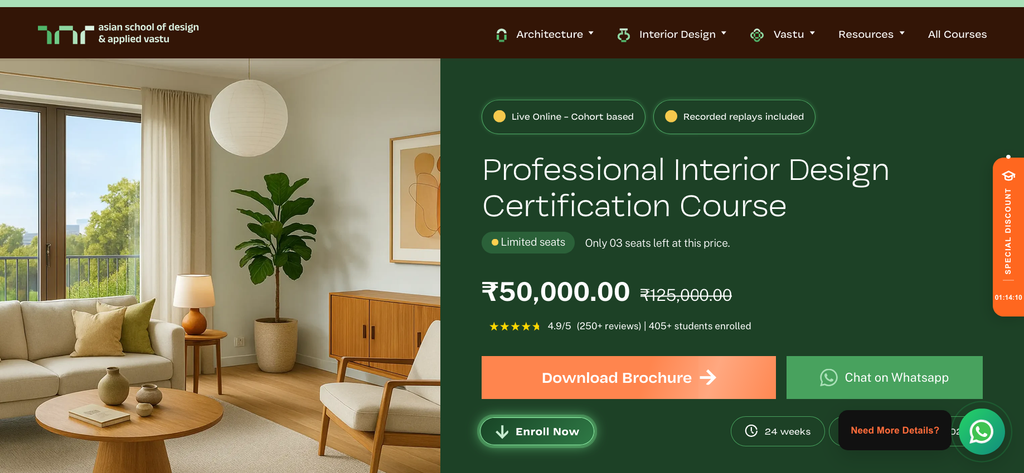
Our 6-month Professional Interior Design Certification Program is designed as a complete, practical learning experience for aspiring interior designers. It covers the core design concepts, technical skills, industry-relevant software, residential and commercial projects, 3D visualisation, and portfolio development, with a focus on the skills needed to work in the UAE and other international markets.
If you are planning to start your interior design career in the UAE and want to learn from the basics while building a professional portfolio, enrol in our upcoming batch and take your first step towards becoming a job-ready interior designer.

Jasmine Ahluwalia is a Licensed Architect, Interior designer, Global Vastu consultant and the founder of ASDAV.
She is a graduate of Scuola Master F.lli Pesenti, Politecnico di Milano, and brings strong global exposure through academic learning and professional design projects. Her background combines architecture, interior design, and applied design education.
Before founding ASDAV, Jasmine worked as an assistant professor at Amity School of Architecture and Planning, Amity University Noida. Her research covers sustainable architecture, urban heat island reduction, and circular economy practices in construction. Her work has been published in Scopus indexed and peer reviewed journals as well. She also has strong international on-site experience from countries like Canada, Mauritius, UK, and many more.
Through ASDAV, she has trained more than 500 students across 25 cities. The ASDAV platform has 12+ instructors from IIT, SPA, CEPT and NID, and has delivered over 200 live learning sessions. Her mission is to bridge the gap between design education and real industry expectations, to deliver real growth for her students.
She designs spaces for a living, but her favourite project is designing careers.