

 See more from ASDAV on Google
The UK civil engineering sector supports major infrastructure projects, construction activity, transport networks, and property development across the country.
Market growth, public infrastructure spending, construction output, project costs, and workforce demand all shape the sector’s performance.
This statistical roundup brings together key UK civil engineering statistics from recent industry reports and official sources. It covers market size, growth forecasts, construction output, infrastructure spending, project costs, and skills shortages, providing a clear view of the sector. All data sources are attached at the end for verification.
Methodology: How we collected data
We reviewed data from Market Research Future, Grand View Research, the UK Office for National Statistics, UK government reports, and infrastructure sources. We analyzed market size, growth, construction output, infrastructure spending, project costs, and workforce demand. We used the latest available figures and clearly separated historical data from forecasts.
Key UK civil engineering statistics
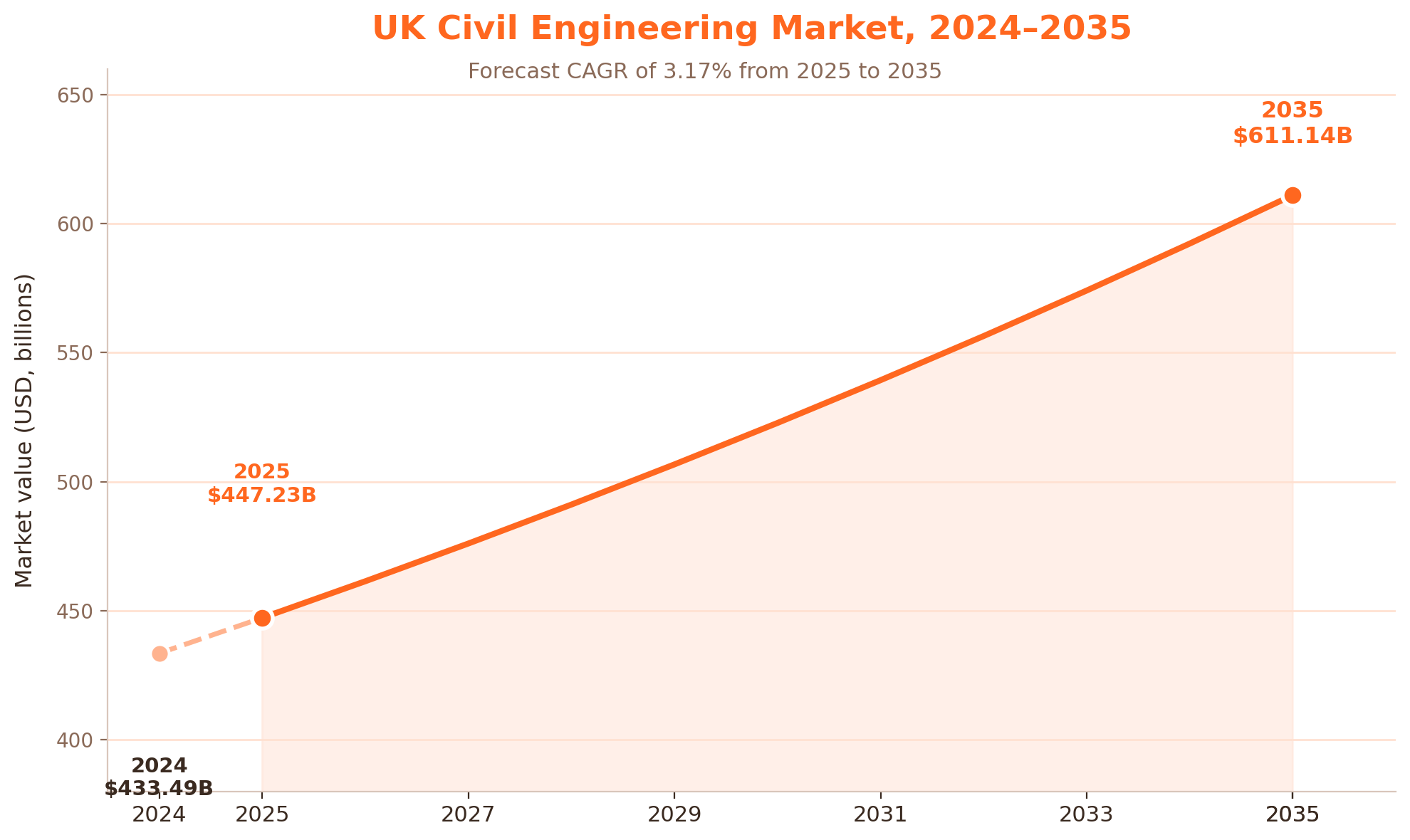
- The UK civil engineering market reached $433.49 billion in 2024 and could grow to $611.14 billion by 2035.
- The UK civil engineering market is forecast to expand at a CAGR of 3.17% between 2025 and 2035.
- The UK contributed 3.8% of global civil engineering revenue in 2025.
- UK public sector spending on roads and railways reached approximately £19 billion in 2023 to 2024, excluding HS2.
- Civil engineering skills shortage vacancies increased by 84% between 2022 and 2024.
- The UK recorded 5,900 civil engineering skills shortage vacancies in 2024.
- The UK is expected to require 1,470 additional civil engineers every year from 2024 to 2029.
- Construction was the largest UK civil engineering service segment in 2024, with a reported market value of $250 billion.
1. UK civil engineering market size and growth
The UK civil engineering sector covers major infrastructure, construction, design, and maintenance activities nationwide. Market projections show continued growth through 2035, while the UK’s share of global civil engineering revenue reflects its position in the wider international market.
- The UK civil engineering market was valued at $433.49 billion in 2024 and is projected to reach $447.23 billion in 2025. The market is expected to reach $611.14 billion by 2035, growing at a CAGR of 3.17% from 2025 to 2035.
- The UK accounted for 3.8% of the global civil engineering market by revenue in 2025.
Here’s the UK map by search demand for ‘civil engineering’ as per Google Trends:

2. UK construction output and activity
Construction output shows how actively the UK industry is delivering new projects and maintenance work. Recent figures show changes across new construction and repair activity, with several sectors recording lower output while private housing maintenance showed stronger monthly activity in July 2026.
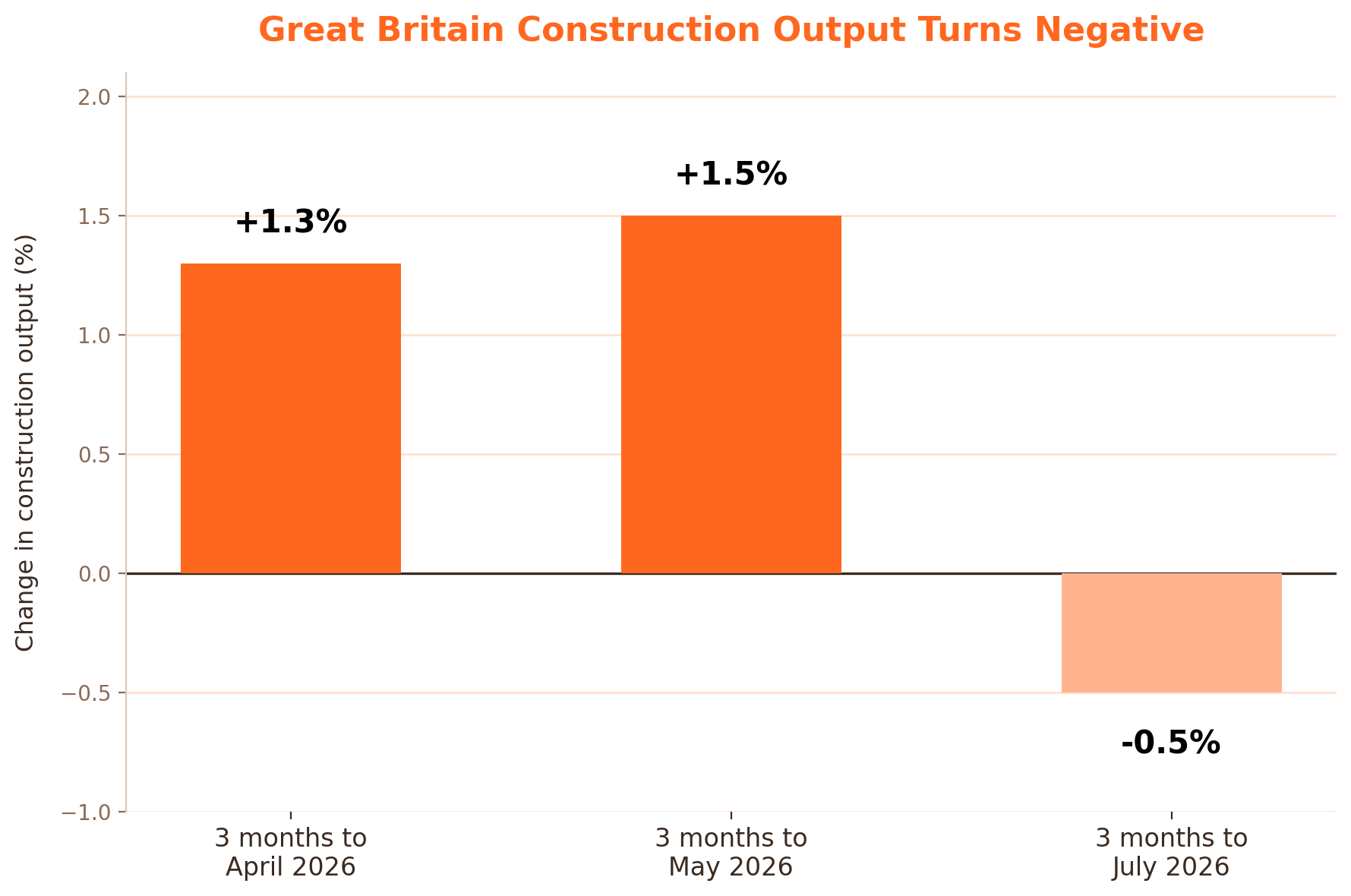
- Total construction output in Great Britain fell by 0.5% in the three months to July 2026, following growth of 1.3% in the three months to April and 1.5% in the three months to May.
- New construction work decreased by 0.4%, and repair and maintenance output fell by 0.7% in the three months to July 2026.
- Six of the nine construction sectors recorded lower output in the three months to July 2026. Private housing repair and maintenance recorded the largest negative contribution, with output falling by 1.7%.
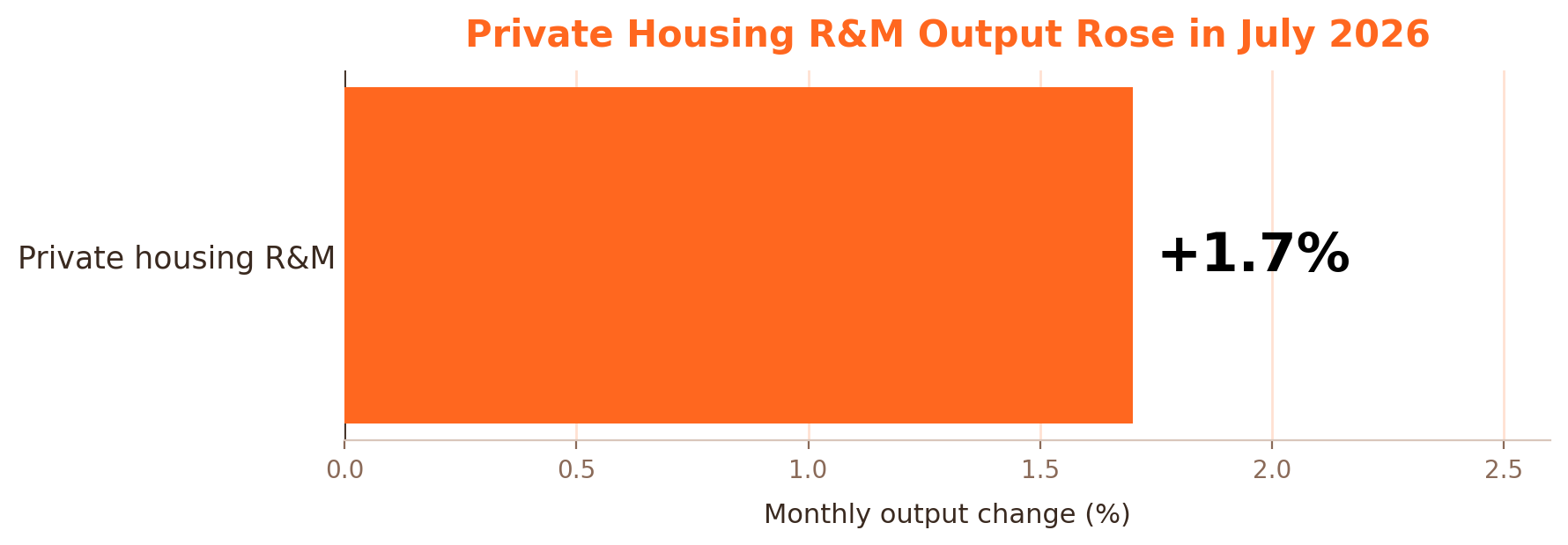
- Private housing repair and maintenance output increased by 1.7% in July 2026, making it the main contributor to the monthly rise in repair and maintenance activity.
- Private housing new work output fell by 4.9% in July 2026, making it the largest negative contributor to the monthly change in total new work.
3. Civil engineering market segments
Civil engineering activity covers several service and application areas, including construction, planning, design, maintenance, infrastructure, and real estate. Available market data shows the size of major segments and highlights where future growth and spending could drive demand for civil engineering services.
- Construction was the largest service segment in 2024, with a reported market valuation of $250 billion, while Planning and Design was identified as the fastest-growing service segment.
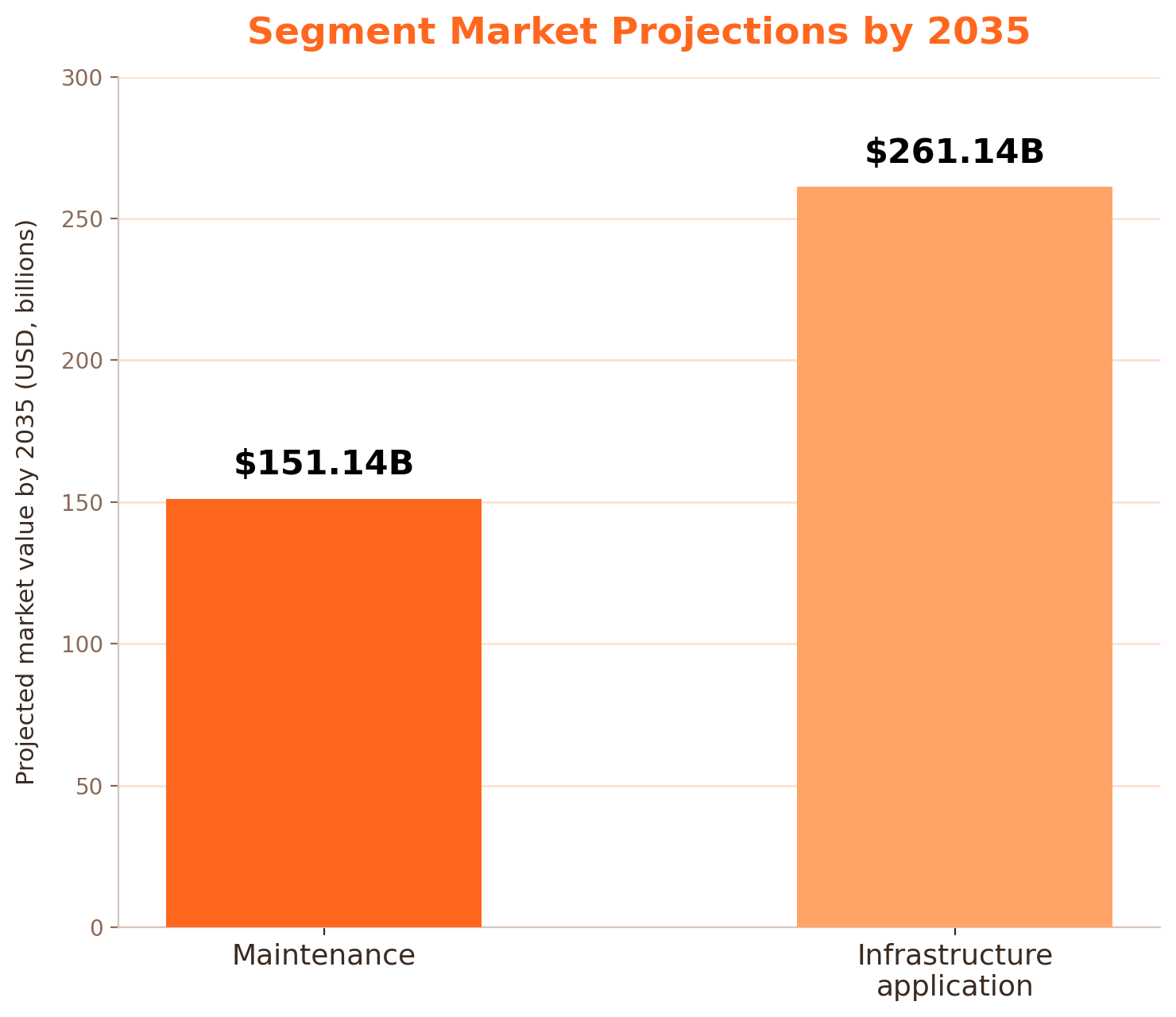
- The Maintenance segment is projected to reach $151.14 billion by 2035, while the Infrastructure application segment is projected to reach $261.14 billion.
- The Real Estate application segment had a reported valuation of between $150 billion and $210 billion in 2024.
4. Customers and public infrastructure spending
Civil engineering projects receive funding from both private and government customers. Public spending also supports essential road and railway infrastructure across the UK. The figures show how spending was divided between private customers, government customers, roads, railways, and local authority road projects.
- The Private customer group was valued at $260.45 billion in 2024, compared with $173.04 billion for the Government customer group.
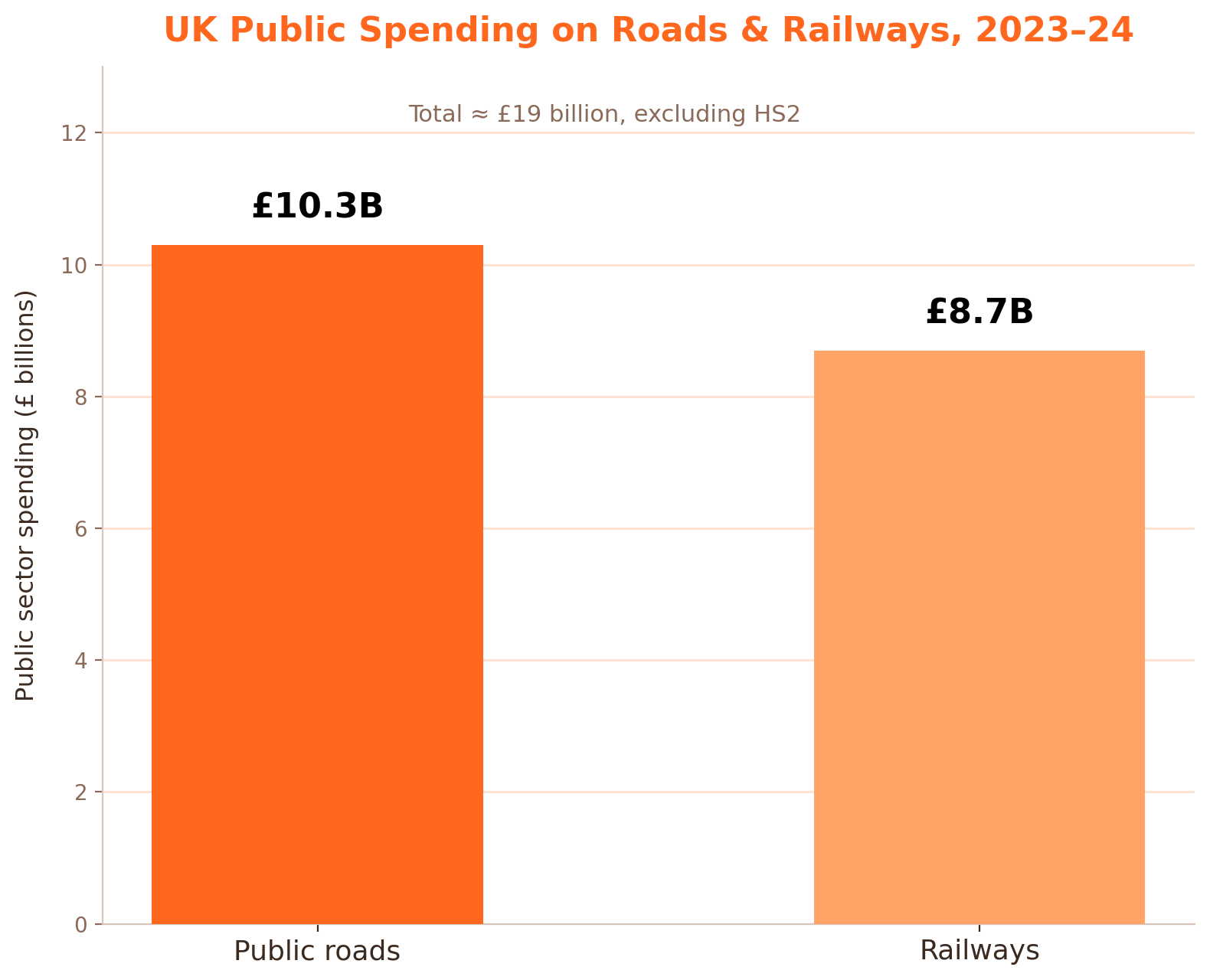
- The UK public sector spent approximately £19 billion on maintaining and enhancing public roads and railways in 2023 to 2024, excluding HS2. Public roads received around £10.3 billion, while railways received approximately £8.7 billion.
- Local authorities accounted for more than half of road spending, with £5.6 billion spent in 2023 to 2024.
5. Roads and railway infrastructure
Road and railway infrastructure represent major areas of UK civil engineering spending. National Highways and Network Rail direct significant portions of their budgets to enhancement work, while rising railway track renewal costs show the financial pressure of maintaining and improving existing infrastructure.
- Enhancement work accounted for around 55% of National Highways’ annual spending, while enhancements represented around 27% of Network Rail’s annual spending.
- Conventional railway track renewal costs increased by an average of 7% per year in real terms between 2014 and 2015 and the period covered by the Office of Rail and Road analysis.
6. Construction costs and project overruns
Rising construction costs and project budget overruns remain important issues for UK infrastructure delivery. Available evidence shows that construction costs have increased faster than GDP per capita, while a significant share of analyzed public road projects exceeded their original contract budgets.
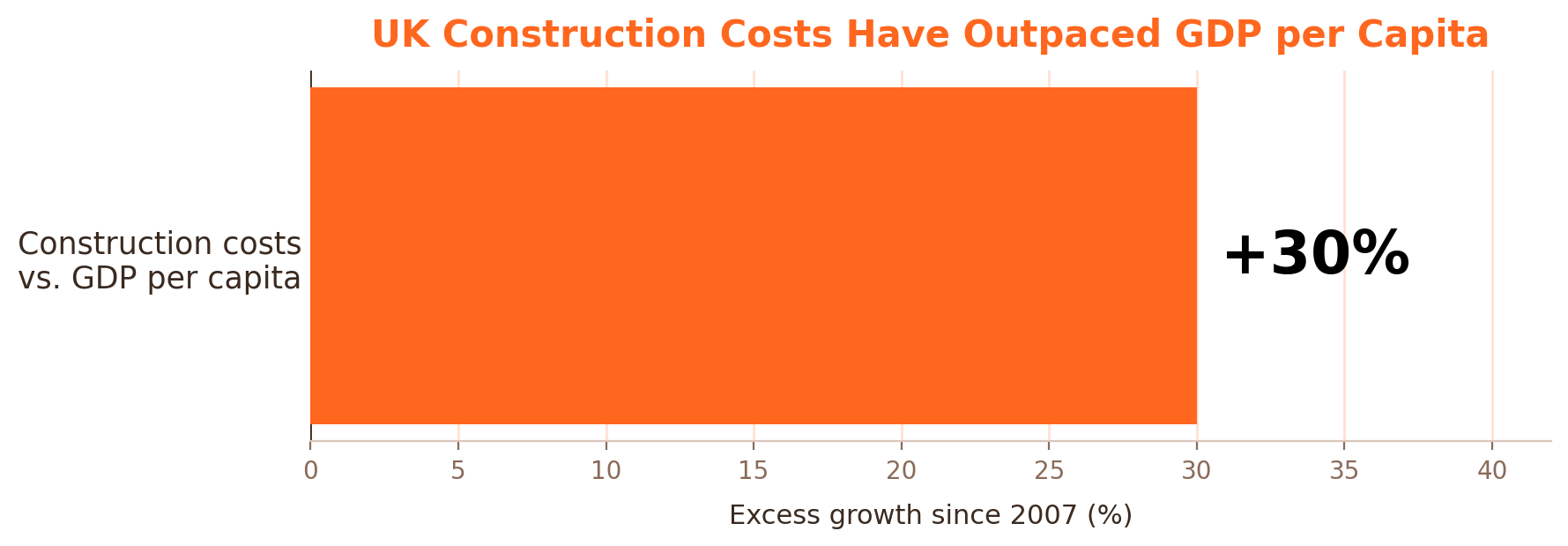
- UK construction costs have risen by around 30% more than GDP per capita since 2007, according to National Infrastructure Commission evidence cited by the CMA.
- Between 29% and 79% of public road projects analyzed by the CMA exceeded their contract budgets, with the share varying by public authority.
- Average cost overruns for these public road projects ranged from 12.2% to 19.0%, depending on the authority.
7. Civil engineering skills and workforce
The UK civil engineering industry faces growing demand for skilled workers. Skills shortage vacancies increased sharply between 2022 and 2024, while industry forecasts indicate that thousands of additional civil engineers will be needed to support projected growth in construction and infrastructure work through 2029.
- There were 5,900 skills-shortage vacancies in civil engineering in 2024, up 84% from 2022 to 2024.
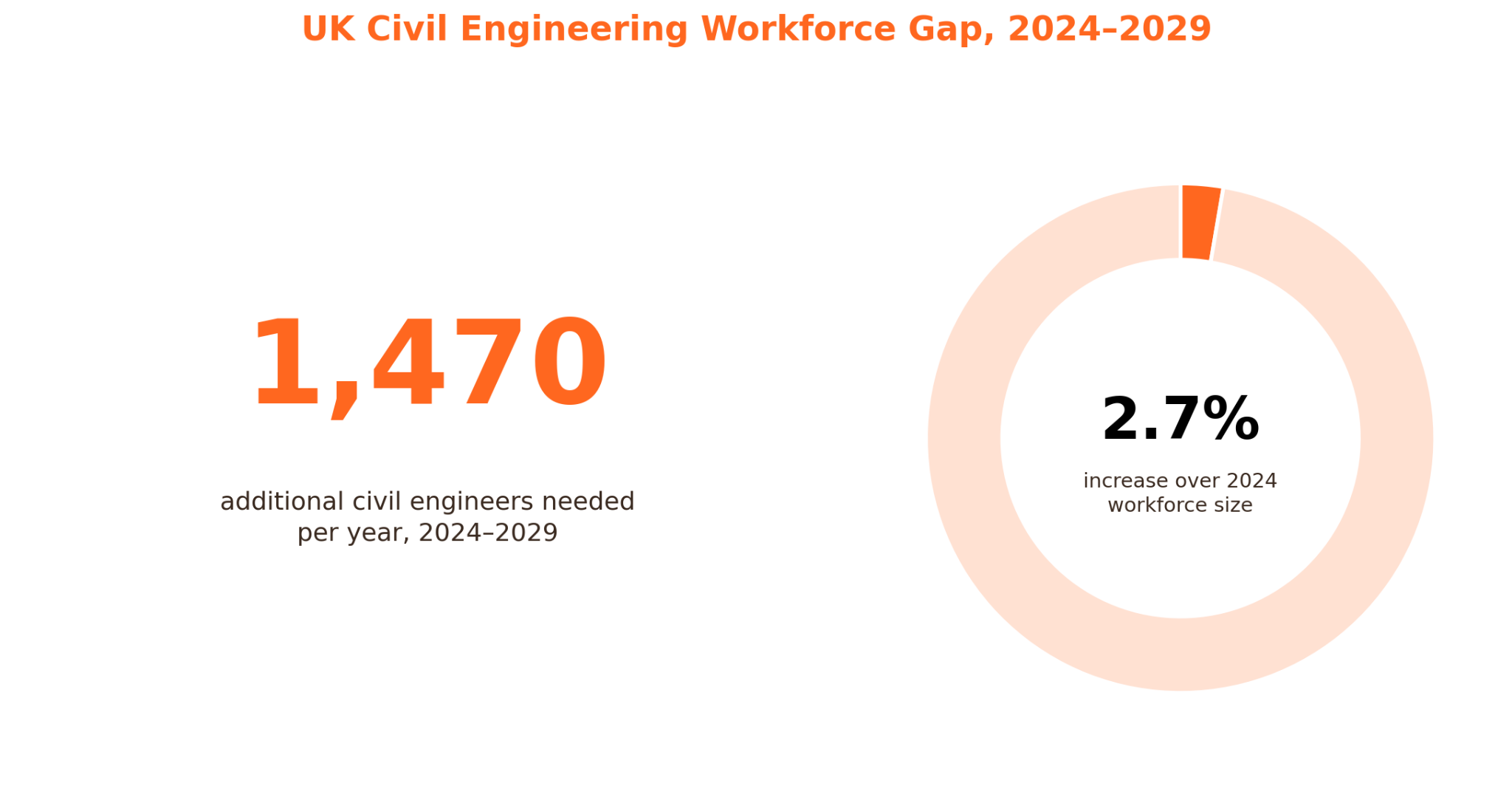
- The Construction Industry Training Board estimated that the UK would need an additional 1,470 civil engineers every year between 2024 and 2029 to meet projected growth in work. This represents a 2.7% increase over the 2024 civil engineering workforce.
💡 Explore further data studies at ASDAV:
- 30+ Interior Design Statistics
- 10 Must Know BIM Usage Statistics For Architects
- AI in architecture statistics
Final words
The UK civil engineering sector is expected to remain closely linked to infrastructure investment and wider construction activity over the coming years. As projects become more technology-driven, professionals also need practical skills that support modern design and construction workflows.
For learners looking to build these skills, ASDAV offers a Revit and BIM Certification Course designed around practical, industry-focused learning.
The 12-week course covers Revit and BIM workflows through live sessions, expert instruction, and real-world assignments. It can help learners prepare for roles such as BIM Consultant and Revit Specialist. These skills are relevant to professionals working across building design, construction planning, and the wider built environment.
With a focus on hands-on learning, ASDAV helps learners develop technical capabilities that align with the growing use of digital tools in the construction industry. Contact ASDAV to learn more about the course, curriculum, enrolment, and upcoming batches.
FAQs
What was the size of the UK civil engineering market in 2024?
The UK civil engineering market was valued at $433.49 billion in 2024. It is projected to reach $447.23 billion in 2025 and $611.14 billion by 2035. The market is expected to grow at a CAGR of 3.17% between 2025 and 2035.
How much did UK construction output change in 2026?
Total construction output in Great Britain fell by 0.5% in the three months to July 2026. New construction work declined by 0.4%, while repair and maintenance output dropped by 0.7%. Six of the nine construction sectors recorded lower output during this period.
What share of global civil engineering revenue came from the UK in 2025?
The UK accounted for 3.8% of global civil engineering market revenue in 2025. This figure reflects the country’s contribution to worldwide civil engineering activity across areas such as construction, infrastructure, planning, design, maintenance, and real estate-related projects.
How much did the UK spend on public roads and railways?
The UK public sector spent approximately £19 billion on maintaining and enhancing public roads and railways in 2023 to 2024, excluding HS2. Public roads received around £10.3 billion, while approximately £8.7 billion went toward railway infrastructure during the same period.
How many civil engineering skills shortage vacancies were recorded in 2024?
There were 5,900 civil engineering skills shortage vacancies in 2024. The number increased by 84% between 2022 and 2024, showing a sharp rise in demand for skilled workers across the profession and highlighting the workforce challenges facing the sector.
How many additional civil engineers will the UK need each year?
The UK is expected to need 1,470 additional civil engineers each year between 2024 and 2029. This annual requirement represents a 2.7% increase on the 2024 civil engineering workforce and is intended to support projected growth in construction and infrastructure work.
Which civil engineering service segment had the largest market value in 2024?
Construction was the largest service segment in 2024, with a reported market value of $250 billion. Planning and Design was identified as the fastest-growing service segment, while the Maintenance segment is projected to reach $151.14 billion by 2035.
Data Sources
- https://www.marketresearchfuture.com/reports/uk-civil-engineering-market-55906
- https://www.ons.gov.uk/file?uri=/businessindustryandtrade/constructionindustry/datasets/outputintheconstructionindustry/current/bulletindataset2.xlsx
- https://www.grandviewresearch.com/horizon/outlook/civil-engineering-market/uk
- https://assets.publishing.service.gov.uk/media/6a0ea16d9c0df135284ec751/Final_Report_.pdf

Jasmine Ahluwalia is a Licensed Architect, Interior designer, Global Vastu consultant and the founder of ASDAV.
She is a graduate of Scuola Master F.lli Pesenti, Politecnico di Milano, and brings strong global exposure through academic learning and professional design projects. Her background combines architecture, interior design, and applied design education.
Before founding ASDAV, Jasmine worked as an assistant professor at Amity School of Architecture and Planning, Amity University Noida. Her research covers sustainable architecture, urban heat island reduction, and circular economy practices in construction. Her work has been published in Scopus indexed and peer reviewed journals as well. She also has strong international on-site experience from countries like Canada, Mauritius, UK, and many more.
Through ASDAV, she has trained more than 500 students across 25 cities. The ASDAV platform has 12+ instructors from IIT, SPA, CEPT and NID, and has delivered over 200 live learning sessions. Her mission is to bridge the gap between design education and real industry expectations, to deliver real growth for her students.
She designs spaces for a living, but her favourite project is designing careers.
Explore more

























































![Top 5 Revit Architecture Courses In Delhi [With Certification]](https://www.asdav.com/wp-content/uploads/2026/08/Top-5-Revit-Architecture-Courses-In-Delhi-With-Certification.jpg)
















Not Sure Where To Start? Let's Talk

Fill the form below to get Free 1:1 counselling